Showing posts with label economics. Show all posts

Wednesday, October 22, 2014

On Investing: Long Live the Petrodollar

The rampant inflation of the money supply used to be a grave concern. Stealing our purchasing power by stimulus, quantitative easing and monetizing the debt drove me crazy by whatever name it was called. That most people didn't even notice the plundering was all the more infuriating. The seeming inevitability of the American dollar's collapse affected how I lived and invested for college and retirement. But the mysterious death of Christophe de Margerie, CEO of oil giant Total SA in a Moscow plane crash, has cleared up everything.
Another plane crash takes out dollar foe.


He stated oil sales don't have to be transacted in the American dollar, per this coverage. Now he's dead. Remember Libya and Benghazi? Gadhafi tried to introduce a gold-backed dinar per this account. Dead. The Libyan "rebels" even established a new central bank within hours of the takeover. Sure, that's what always happens after oppressed people rise up and take control. And Iraq? Saddam Hussein tried to sell oil without the American dollar, per this news and comment.

As long as the Federal Reserve private central banking cartel can murder anyone who dares slight the American dollar (along with everyone else unlucky enough to be on the same plane), as long as the USA will put its military might behind changing the regime in any country that dares slight the American dollar, then we Americans can feel safe in accumulating dollars. The cost in propping up the dollar, of course, is endless war.  But isn't that just...so worth it?

So, go to work, put your dollars in the bank. Invest in stocks. The ever-inflating money supply will cause stocks to go nowhere but up - in nominal value only. But who cares about such details? Now move along, there's nothing to see here.  

Thursday, February 14, 2013

Drones to drop bomb on home values?

Soon we'll have 30,000 drones flying over our homes here in America. We may not know where they are but as shown in this PBS documentary, "Rise of the Drones", they will certainly know where we are. Some local police departments are eager to get their hands on these drones to watch over their constituents, some want drones to shoot their constituents and some in the federal government are eager to provide funding to help militarize local law enforcement and put a drone on every home. In some states like Texas and cities like Seattle (page removed), officials have passed laws limiting or banning the use of these drones.

So, how much is it worth to you to live where drones are nowhere to be seen versus buzzing freely over your swimming pool and backyard barbecue, recording every move everyone ever makes - watching you to be sure you are attentively watching your children in the pool? That you're serving FDA-approved foods and drinks? With a government-certified lifeguard present? Just how much do we value privacy? We may soon find out when homebuyers are forced to weigh the pros and cons of living under drones 24/7 just as they weigh the pros and cons of the school system, commuting time and access to shopping.

I'll be curious to see how the threat of a drone strike upon one's home by Hellfire missile affects the housing price and the homeowners insurance rates. Will home destruction by presidential kill list require a rider? At what point will people sell their homes and move to states trying to be drone-free like Texas? And how much of a premium will drone-free skies command? How much of a loss will home sellers be willing to bear to get away from the constant surveilling and recording of their families' lives? And by then, will we even be allowed to move?

Anyone working in an economic development department of government at any level would be smart to work with their legislatures to pass laws banning the use of drones for any reason - and then market the hell out of their drone-free skies to attract companies and workers who understand the dangerous ramifications of a constant drone infestation. If you're not sure life will be any different once we're under 30,000 drones, just take a look at the thousands of innocent Pakistanis affected by our drone program. You'll have to do some digging - most of them are buried.

Tuesday, November 20, 2012

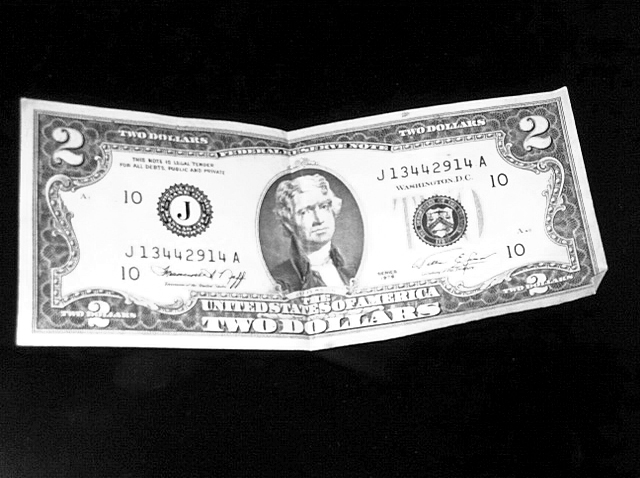
Funny as a Two-Dollar Bill

While being given change at Universal's Islands of Adventure, I noticed this two dollar bill in the drawer and asked to have it instead of two singles:

Cashier: Sure...it'll be worth a lot someday.
Me: Yeah, tomorrow it'll be worth a dollar.


Wednesday, December 28, 2011

This Practical Plan Solves Income Inequality

A Dec. 26th Associated Press story in the Providence Journal stated that President Obama and Mitt Romney both want to fix income inequality but by using different methods. The story didn’t ask whether income inequality is a problem or whether any president has the legal right to “fix” it. It is written as if income inequality is universally accepted as a problem that must be fixed. The occupiers and a variety of have-nots agree, demanding “We must close the wealth gap!”

Pretend with me for a minute that our country has no rule of law, no Constitution and the government forces everybody to put every cent of wealth into a big pot. Then it’s divided evenly by the number of people in the country and we all start tomorrow with the exact same amount of money. “Hooray! We’ve eliminated the wealth gap!” The politicians cheer, patting themselves on their backs.

Then what?
Then Senator Obama tries to convince Joe the Plumber that spreading wealth around by stealing it from some people and giving to others is "good for everybody." Americans largely ignore that this is illegal, unconstitutional, immoral and against any code of conduct an elected official would be expected to honor.

Some will go to Las Vegas and lose their “fair share” in the casino within minutes. Others will also go to Las Vegas and earn money working at a trade show. Some may start companies while others smoke crack in a back alley. Some will lend their money to a bank and instantly earn a miniscule amount of interest. Within minutes, we will once again be faced with gross income inequality and a widening wealth gap.

Then what?

Well, the only way to fix this is for the government to force everybody to put every cent of wealth into a big pot. Then it’s divided evenly by the number of people in the country and we all start over with the exact same amount of money. Some will go to Las Vegas and lose their “fair share” in the casino within minutes. Others will go to Las Vegas and earn money working at a trade show…etcetera, etcetera. You get the idea. Then once again faced with rising income inequality and a widening wealth gap, we’ll have no choice but to demand the government fix it by collecting our wealth in a big pot and handing it back.

As anyone can see, this very concept of income inequality is as ridiculous as the theft by force of government pushed as the solution. The very idea that everyone is supposed to earn the exact same amount of money regardless of his/her production or contribution to society cannot be more absurd. Does anyone in Green Bay truly believe that Aaron Rodgers and backup Matt Flynn should earn the same salary? Even the NFL Players Association union wouldn’t try to argue that case. If even unions agree the idea of income inequality is wrong for sports business then isn’t it wrong for every business?

Much is written promoting income inequality as a great evil but I haven’t found a compelling case for the virtues of its reverse: income equality. If one exists, please let me know. “When you spread the wealth around, it’s good for everybody,” as then Senator Obama said to Joe the Plumber, is not so compelling a case that it justifies stealing from one person to give it to someone else.  

Tuesday, November 08, 2011

Top reads for protesting, occupying, rallying

For those peaceably assembling in the streets and for those taking long rides to the protest rallies, there's a lot of time to read up on how our country arrived at this critical juncture in history and on what needs to be done to allow the economy to grow. Read these books before talking to reporters on camera or shooting a YouTube video to be sure you not only fully understand the issues but also are able to articulate them for others who may lack such clarity on the importance of these protests:

A Short History of Money and Banking, Gouge: the economic turmoil of today seems little different from the economic turmoil that plagued several periods during the 1800's, and much of today's troubles would have been predictable if anyone had paid attention to what had already happened in the past - and is sure to continue happening in the future if dramatic changes are not made.

A capitalist among the socialists occupying Wall Street - advertising works! If you're protesting, take a look at these books to be sure you not only fully understand the issues but can articulate them for the news media in seven-second sound bites.
Economics In One Lesson, Hazlitt: this essential work uses 23 real-life examples to illustrate the interconnected nature of the global economy. The value of stimulus projects, the impact of taxation on production, the relationship of employment and wages and the use of printing money or "monetizing the debt" are just some of the issues covered.

Fortune Tellers: Inside Wall Street's Game of Money, Media and Manipulation, Kurtz: this book from CNN's media watchdog reporter reveals how the investment banks, analysts, public companies and media such as CNBC, CNN and the Wall Street Journal effectively conspire to dupe individual investors of their money.

Animal Farm, Orwell: see how the downtrodden, overworked animals rise up against their capitalist oppressors! When they finally learn the truth about how their most charismatic leaders take advantage of their idealism, it's too late.

Night, Wiesel: If you think outsourcing jobs, Wall Street bailouts and paying a portion of one's own healthcare represent the pinnacle of man's capacity for inhumanity, cruelty and brutality against his fellow man then read this true story about what happened to Elie Weisel - and millions of other innocent people - when the Nazis came to town. 

Washington's Crossing, Fischer: You don't need to live as close to the town of Washington's Crossing as I do to marvel in astonishment at what Washington's army endured to oust the British and the Hessians from Trenton and the surrounding area. In light of President Obama calling Americans soft, I wonder if today's Americans would bother to go through what Washington's troops endured if only for their freedom and that of their families. You'll be amazed what people risked so that we would be free to peaceably assemble in the streets today.

If there are other books you think would be worthwhile for people protesting or considering protesting, please put the title and author in the comment box. I'd be happy to take a look.

Tuesday, April 12, 2011

"A Must-Read!" Book Review of Economics In One Lesson


I read Economics in One Lesson by Henry Hazlitt more than a year ago with my then 10-yr. old son. The knowledge in it is so profound that I’ve put off writing this review for fear that I could never do it justice, and I’m sure I haven’t. But there’s no time to wait – you need to read this book now.

I’ve read a number of books about economics and banking, history and politics, and without a doubt, Economics In One Lesson stands out as the most important book on the subject area.

It is setup as a series of 23 different examples describing everyday occurrences to illustrate fundamental economic principles. How a broken window impacts the overall wealth of the community is among the most famous of these examples. Other examples address the value of public works projects, the importance of exports, the impact of taxation on production, the relationship of employment to the minimum wage and the inflationary result of printing money.

Though written more than 50 years ago, the examples remain all too relevant today, unfortunately. In fact, for nearly every example, I was able to clip an article from the newspaper or print one from the Web documenting how the same issues are sadly alive today. “Price Controls Hamper Rise of Generics”, Wall Street Journal, for example, revealed how the government of the Philippines set price controls on branded drugs to lower their cost only to find the artificially reduced profits caused retailers to cancel planned store openings and stop hiring. Hospitals raised other prices to recoup the loss of revenue from drugs and the once-growing generic drug manufacturing industry stalled since the spread between its prices and the now-lower branded drugs has been cut. Now there are more people unemployed and less medicine available. If only government officials in the Philippines had read this book before causing so much needless and predictable suffering.

In “The New Cannery Row”, for a second example, Wall Street Journal editors reveal what happened to the tuna industry in American Samoa when our Congress required the U.S. territory to raise its minimum wage from $3.26 an hour to $7.25 an hour by 2015. Well, what do you think happened? Chicken of the Sea closed its plant. StarKist cut more than half its workforce. Thousands were put out of work. The minimum wage hike pushed unemployment from 10% to 30%. Seems workers in Thailand are willing to clean fish for $.75 an hour. Since our Congress failed to grasp this, we get to send $18 million of our taxes to Samoa as compensation. Oops.

Had our Congressmen read Hazlitt’s analysis of each occurrence and his predictions for the outcomes of each occurrence under different economic policies they would’ve understood how raising and lowering the minimum wage affects employment. In fact, the answers to nearly every economic challenge that seems to confound everyone from TV talking heads to Federal Reserve members and the President’s team of economic advisors are in this book, quickly and simply laid out for anyone to understand – regardless of a passing grade in Economics 101.

In fact, the policy answers are so obvious that my 10-yr. old, upon noticing the “50th Anniversary Edition” sticker on the cover, was baffled that the world could be in such economic chaos when the answers have been right here for 50 years. He’d thought we were reading a new book –it was unfathomable that most of our political leaders have ignored the obvious for so long while continually throwing money at policies that are proven to fail everywhere they’ve been implemented.

After reading Economics In One Lesson, it’s easy to see through all of the fear and hysteria driving today’s pseudo-journalists on the news. I highly recommend Economics In One Lesson. This book needs to be at the top of your reading list.

Wednesday, June 23, 2010

Everything I Need to Know About Economics I Learned Playing Age of Empires III

If Age of Empires III wasn’t called a video game, it could be called an economics simulation. Then it could be used as a tool for learning instead of dismissed as a waste of time. In this PC game, each player starts a colony with an explorer and seven settlers. To survive and thrive, settlers must set to work gathering berries and hunting for food, cutting down trees for buildings and mining metals for money. As the colony grows, more settlers arrive. Hunting and gathering are replaced by farming and domesticating livestock, mining is replaced by banking and woodcutting is replaced by factory production. A market promotes the efficient conversion of commodities and money from one to another – minus a percentage as a brokerage fee. And all of this needs to be humming along while accounting for the colony’s defense against the colony on the other side of the plain. It would be impossible to win at this game without understanding several fundamental principles involving economics, defense and government. And lo and behold, these principles are learned and retained simply by playing the game. No textbooks required. For example:

1. Everybody contributes. Every person living in the colony needs food and shelter. Everyone is, to some degree, a cost to the colony. Therefore, every member of the colony needs to contribute, or in economic terms, needs to produce goods. A settler who isn’t farming must be building or mining or otherwise producing. An idle settler is a burden draining the colony of resources. So destructive idleness is, in fact, that the game alerts the player if a settler is left idle between tasks. Watching TV, lounging by the pool and vacationing on the beach are economically unthinkable. If you’re not helping, you’re hindering. There certainly aren’t any inspectors, administrators or other officials living off of the work of others.

2. Opportunity cost. Since resources are limited and costs are involved in gathering resources, how the limited resources are allocated requires careful, thoughtful decision making. Should the available wood be used to build houses to support and attract additional settlers or to build a mill to boost agricultural production? Should the available gold be invested in technological improvements that boost production of goods or in raising an army to protect the colony? Each purchase is at the expense of another purchase and each decision has consequences that impact everyone in the colony. Now don’t forget to consider that military personnel require food and shelter but don’t contribute in terms of economic production. With a finite amount of population permitted (200), each soldier represents one less settler able to produce goods.

3. Sustainability. The game starts with numerous head of bison roaming the plains, a number of gold mines and lush forests. But eventually, these resources will be depleted so alternative methods of production must be found. Domesticating livestock, farming and using advanced materials, for example, must be considered and they must be considered before resources expire, not after everyone is starving.

4. Technology is good. Settlers can cut wood at a given rate but investing in a log flume and sawmill boosts the production rate. Settlers can plant a farm but studying seed technology boosts the production come harvest time. Raising an army of musketmen is fine but improving their weapons with rifling allows the same number of soldiers to more effectively defend the colony. It would be unthinkable to believe that it’s better to use a lot of human labor to perform a job slowly when a few tools can help fewer people perform a job faster and easier, freeing the human labor to contribute in another area.

5. Value of services. It’s common for politicians and TV commercials to slam “transaction fees”, “brokerage fees” and “convenience fees”. We’ve been told for decades that providing services should be free of charge as if they offer no value. In Age of Empires, players are grateful for the ability to instantly exchange one type of commodity for another. This ability has value and for this ability to trade goods, a transaction fee is paid. This fee pays for the service being provided - the ability to easily exchange goods. It is no different than a credit card company offering the ability to write a check for instant access to cash and earning a percentage for both the service and for bearing the risk of extending credit. Yet people have been taught to become irate when required to pay for services like these, though without them our economy could not function as smoothly.

6. Deterrence. At first, while I was carefully and methodically sending my settlers hunting, gathering and building, my opponent’s army would quickly arrive and destroy my colony. Game over. Then my 11-year old son, who convinced me to try this game, explained how to prevent it. “You don’t need to raise a whole army – that’s too expensive – you just need a few soldiers so the other guy won’t attack.” Aha! A deterrence. The opposite of which I’ll call an invitation. It’s a concept that’s self-evident to a pre-teen but seemingly alien to our leadership in Washington D.C.

Video games have come a long way since Space Invaders and Asteroids. And while vile, cop-killing, Grand Theft Auto-style games capture the headlines, hundreds of other games that don’t grab headlines would be labeled educational if they simply weren’t so much fun to play. Parents need to rethink their perception of video games and stop lumping everything on a computer or console as a wasteful diversion away from productive, educational activities. It may be time to recognize that some video games are both productive and educational and it’s their extra element of fun that makes the learning process so effortless.

Tuesday, November 10, 2009

We Needed the Berlin Wall

The Berlin Wall provided an omnipresent reminder that life on the eastern side was different from life on the western side. The wall was a tangible symbol that millions of innocent people were being held under oppressive, socialist rule on one side while we on the other side enjoyed life as free (relatively) capitalists. This stark contrast demonstrated the obvious advantages of political and economic freedom every day for the world to see. If only the wall would be torn down then the whole world would rush to freedom!...Right?

In our arrogance, Americans believed that tearing down the Berlin Wall would unleash the capitalist spirit and yearning for freedom upon the crumbling socialist countries of eastern Europe and the USSR. It didn’t occur to us that the evils of socialism, totalitarianism and the desire to be controlled by the government would spread westward even more quickly.

The Berlin Wall represented all that was evil in the “evil empire” and by contrast all that was good in the West. Americans don't shoot innocent civilians in the back as they race to freedom. Now it’s gone and it’s getting harder to see the distinction between East and West, good and evil. It seems America may have needed this cold war relic to continue appearing "good" even as it strengthens government control over its people, strips away fundamental freedoms and marches towards socialism.

Wednesday, June 24, 2009

Paul's Economy Won't Show Up In Job Creation Reports

There's a small economy bustling outside my house. The lawn service, landscape contractor and pool company are all hard at work while relying on me to be hard at work, too.

The lawn service is a sole proprietor and former stock broker who realized he'd rather be cutting lawns four days per week and going fishing the other three, weather permitting. The landscape contractor started his company a few years ago and now has his own skid steer loader, landscape truck and work crew (freelance). The pool company fixing the sand filter housing is a local, family-owned retailer/service company who hires laborers for the summer.

None of these people waited for the government to "create" a job. And by hiring them, I get specialized services, capabilities and expertise beyond my own. I help keep them in business so their work crews have jobs and I get to keep myself in business, too. And we all provide higher quality work to our Clients because we're doing what we were meant to be doing.

Despite how clear it is to me and millions of other entrepreneurs that my economy is what drives America (and the world if given the opportunity), we're largely shunned by elected officials and the socialist academics they follow. The jobs my economy created aren't counted in the job creation statistics or at least aren't valued as highly as the jobs created at taxpayer expense.

Sunday, July 27, 2008

Introducing Journey to the Center of the Mirth

Take a big gulp and swallow the red pill. Understand there is far more to this world than you'll be shown on the news. Or take the blue pill and go on getting up and going to work every day, doing what they tell you to do, being controlled by the ruling class while actually paying them to control you and your family using your own money they stole as taxes.

On Journey to the Center of the Mirth, I provide commentary on education, economics, media bias, creeping socialism (wait, it's here), the oppressive police state and other pressing issues from the perspective that we have been and continue to be duped into giving up the very freedoms on which this country was founded.

Get ready to journey to places we're not supposed to find. But beware - with knowledge comes not only power but also the burden of responsibility to act.  

Paul is an award-winning marketing professional and owner of epr Marketing, Inc. For marketing guidance and support, click here.

Related Posts Plugin for WordPress, Blogger...